Springs · Roeberta Park
Garage Door Track Repair or Replacement in Roeberta Park
You bought the house with a door that sticks near the top of its travel. The vertical track was screwed tight against the jamb, so the door drags along its stop moulding on every trip instead of swinging clear.
Garage Door Track Repair or Replacement
In plain words
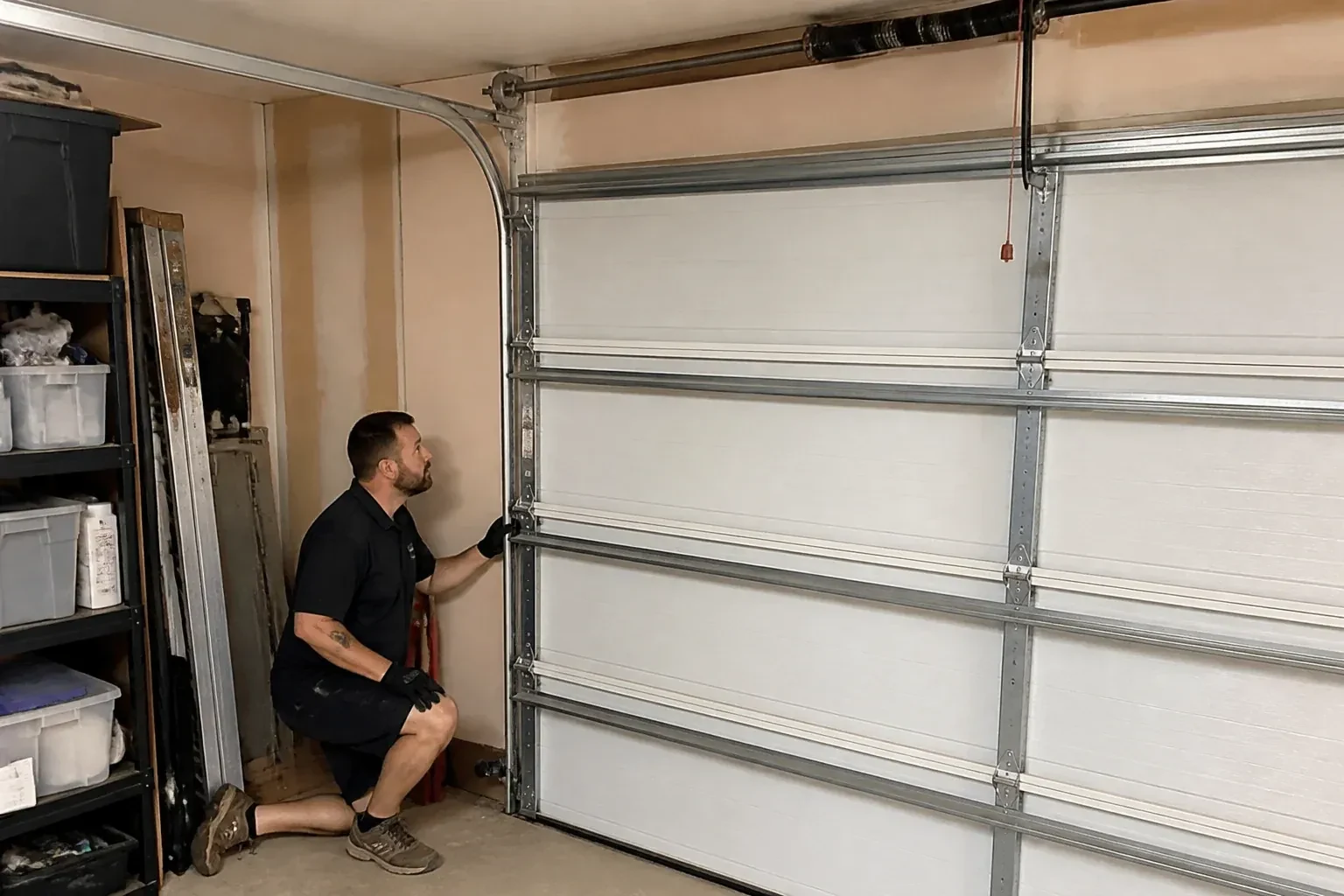
Vertical track is fixed to the jamb in one of two ways, and the assessment begins by reading which one your door has. Bracket-mounted track hangs on a few L-shaped jamb brackets, each lag-screwed into the wood, and can be shifted a little at each bracket to set spacing and plumb. Angle-mounted track uses a full-height continuous angle and is common where sideroom is tight. Either way the vertical run ends at a flag bracket that also carries the horizontal track and, on a torsion door, the spring shaft bearing. Track repair works with those fixings, tightening, replacing or repositioning them so the run sits true.
How the visit goesThe door has started rubbing the frame on the left, leaving a shiny stripe down the weatherstrip. Looking closely, the bracket near the floor stands a finger's width off the wood, its screws half out.
Roeberta Park
How the visit goes
Reading the track system
Track comes in families, and the replacement parts have to belong to the same one. The technician notes the profile, two-inch on nearly all residential doors and three-inch on some heavy ones, and the radius of the curve, typically 12 or 15 inches, which sets how much headroom the door uses. The layout is identified as standard lift, low-headroom dual track or high lift, and the vertical run as bracket-mounted or on a continuous angle. The spring type matters too, since a torsion shaft bearing usually rides on the flag bracket at the top of the vertical track. These details decide what is ordered and how the work is sequenced.
Tension back, balance and opener tests
Once the track is fixed and every roller is seated, the springs are wound back to the turns the door calls for and the clamps come off. The technician lifts the door by hand through its full travel, watching each roller through the curve and along the horizontal run for any catch, and checks that the door holds itself at roughly waist height. It is run up and down several times by hand before the opener is reconnected, and the opener's travel limits and force settings are then adjusted to the newly aligned door, with the reversing test done against a block on the floor. You watch the finished door make the trip before the tools are packed.
Parking and storage habits around the track
Most creased tracks are met by a bumper or a mirror, and most bent horizontal runs by a ladder, a bike or a shelf. It is worth walking the garage after the repair and noticing what sits close to the track: move the recycling bins and the hockey bags a hand's width further in, hang nothing from the back hangs, and leave the horizontal runs clear of stacked boxes. Inside the car, a strip of tape on the floor or a tennis ball on a string marks where to stop. None of this is a chore, and it addresses the single most common reason a straightened track needs straightening again.
Garage Door Track Repair or Replacement
In the van
- Lag screws and track bolts
- Top fixtures
- Track pliers and dead-blow hammer
- Level, plumb line and square
- Perforated angle back hangs
What affects the quote
Same fees day, night or weekend
1Bracket-mounted or continuous angle
Track on jamb brackets is adjusted bracket by bracket, while a full-height angle comes off and goes back as one piece. Each mounting style shapes the time and the fasteners quoted.
2Door size and weight
A tall or double door has longer runs of track and heavier loads on the brackets, and a heavy insulated or wood door may call for heavier-gauge track and more substantial hangers.
3Corrosion and seized fasteners
Lag screws and track bolts rusted solid take time to free or cut, and hardware eaten by salt is replaced rather than reused, which appears in the parts list.
Garage Door Track Repair or Replacement: questions
What is the flag bracket and why does it matter?
The flag bracket is the L-shaped angle at the top of each vertical track. It ties the vertical run, the curve and the horizontal track together, and on a torsion-spring door it also carries the end bearing plate for the spring shaft. Because so much meets there, a loose or bent flag bracket throws the whole path off. The technician unloads the springs before moving it and squares it carefully when it goes back.
How often should the track and its fasteners be checked?
A glance each month from inside the garage, with the door closed, is enough to catch a bracket standing off the jamb or a hanger starting to lean. Twice a year, snug the bracket bolts and lag screws, wipe out the channel, and watch the door make a full trip to confirm every roller stays in the track. The industry guidance also suggests an annual visit by a trained door technician, who checks the track with the rest of the system.
Will track work involve the springs?
Sometimes. The flag bracket at the top of the vertical track usually carries the bearing for the torsion shaft, so if that bracket or the curve has to move, the springs are unloaded first with winding bars and rewound afterwards to the same turns. Simple work on the vertical run below the curve, or on the horizontal hangers, can often be done with the springs left alone. Either way the door is balance-tested at the end.
Springs & Hardware
- Garage Door Hinge ReplacementWatching from inside as the door opens, you can see the gap between the second and third panels…
- Garage Door Cable ReplacementYour older door has springs along the tracks, and one cable has slipped off its pulley and dangles…
- Torsion Spring ReplacementNothing broke outright, but the door has grown heavier each winter, opens more slowly and squeals…
Garage Door Track Repair or Replacement near you
From a stuck door on a winter morning to a planned replacement before the house goes on the market, the services on this page cover what garage doors in Roeberta Park typically need. Each one explains what is checked, how the work is done and what you can expect afterwards.