Openers · Barrillia Park
Garage Door Opener Replacement in Barrillia Park
Since the storm the door behaves oddly: it reverses halfway down for no reason, the light flickers, and the travel limits drift so it either slams or stops short. The board inside is discontinued and the last repair only bought a few months.
Garage Door Opener Replacement
In plain words
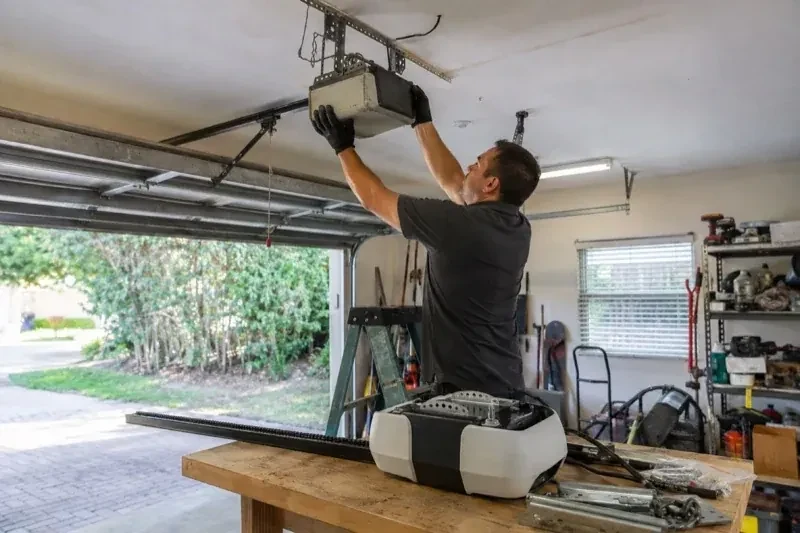
Here is what the day looks like. The technician arrives, watches how the door behaves, then unplugs the old unit and tests the door by hand. Once balance is confirmed, the old head, rail, sensors and control come down and the new rail is assembled on the floor. The header bracket goes into solid framing above the door, the head is hung level from the joists, the door arm and reinforcement are fitted, and the sensors and wall console are wired. Travel, force and safety tests follow, then programming of remotes and keypad. Allow a morning or an afternoon, and a little longer if door work is added.
How the visit goesThe remotes only work from the end of the driveway now, and one of them disappeared with a set of keys last month. Inside the remote are tiny switches instead of a learn button, so excluding the missing one means resetting the switch pattern on every remote and the receiver.
Barrillia Park
How the visit goes
Cold, ice and the garage itself
An attached, heated garage and a detached one that sees minus twenty are different homes for an operator. The technician asks which yours is, checks the operator's rated operating temperature against it, and looks at the threshold for signs the bottom seal has been freezing to the slab, since that is a common reason a door is called heavy in January. Salt tracked in on tires corrodes bottom brackets and cables over time, so those are inspected too. Any manual slide lock on the door is noted so it can be disabled once the operator is fitted, and the side door is checked so there is always a way in during a power cut.
Sensors, console and wiring
The photo eyes are mounted on both sides of the opening no higher than about 15 cm off the floor, aimed at each other until their indicator lights hold steady, and their wire is stapled neatly along the wall and ceiling to the head. The wall console goes at least 1.5 m above the floor, in clear sight of the door and away from moving parts, so it is out of reach of small children and the door can be watched while it runs. Low-voltage wire is kept clear of the rail and the chain. Finally the head is plugged into its grounded receptacle and powered up for the first time.
New codes, and old remotes that no longer work
Every press of a new remote sends a code the operator has never seen before, so a signal recorded in your driveway is useless a moment later. The memory was cleared before your remotes were taught, which means any remote from the old unit, including one that went missing along with your house keys, is now just a piece of plastic. Keep the keypad code to yourself and change it if it has been shared with a contractor or house sitter; the console guide shows how. Adding a remote later is a matter of holding the learn button and pressing the new remote, and the technician leaves you with those steps written down.
Garage Door Opener Replacement
In the van
- Wall control console
- Top-section reinforcement strut
- Low-voltage bell wire and staples
- Remotes and wireless keypad
- Chain or reinforced belt
What affects the quote
Same fees day, night or weekend
1Lighting options
Built-in LED lamps come with most heads, while a motion-activated light, an extra remote light fixture or a brighter light kit for a workshop are add-ons listed on their own.
2Top-section reinforcement
Lightweight steel, glazed and wide doors need a strut or operator bracket across the top section before the arm is attached, so the pull is spread across the door rather than concentrated at one point.
3Door height and rail length
A standard rail suits a 7 ft door. An 8 ft door or a taller custom door needs a rail extension, and a very low ceiling may call for a low-headroom arrangement, each an item on its own.
Garage Door Opener Replacement: questions
What is the red cord for?
It is the manual release. A tug on the red handle unhooks the trolley from the door arm so the door can be raised and lowered by hand while the power is off or the operator is being serviced. It hangs high enough to clear a vehicle roof but low enough to reach without a ladder. To reconnect, most units need only be run once and the trolley picks the arm back up; a few take a second tug.
Should an opener from before the mid-1990s be replaced rather than repaired?
Manufacturers recommend replacing units made before 1993, since most lacked external entrapment protection such as a photo-eye pair, a sensing edge or a constant-contact close control. Identify the model rather than guessing its age or remote type, since a fixed-code remote with small switches is not proof by itself. Replacing rather than repairing brings the sensor beam, a contact-sensitive force setting, remotes whose code changes on every press and a console lock button.
How do I test the safety reversal myself?
Two checks, once a month, each starting with the door fully open. For the first, set a scrap of 2x4 flat on the concrete where the door will land and press the close button; the moment it meets the wood it should climb back to the top. For the second, start the door closing and pass a broom or your arm across the low sensor beam; it should reverse just the same. Any hesitation means a small adjustment is due.
Openers & Access
- Chain-Drive Opener RepairThe chain in the detached garage went orange with rust over the winter, the links are stiff, and…
- Belt-Drive Opener RepairThe door used to glide up with a soft hum.
- Photo-Eye Sensor Alignment or ReplacementSince shelving went up along the garage wall, the door will not close and both sensor lights are…
Garage Door Opener Replacement near you
If your door in Barrillia Park is doing something new, there is a service here for it. Grinding usually points to rollers or hinges. A door that will not lift points to a spring or cable. A door that reverses on its own points to sensors or force settings. We diagnose first, then repair.