Springs · Oro-Medonte
Garage Door Hinge Replacement
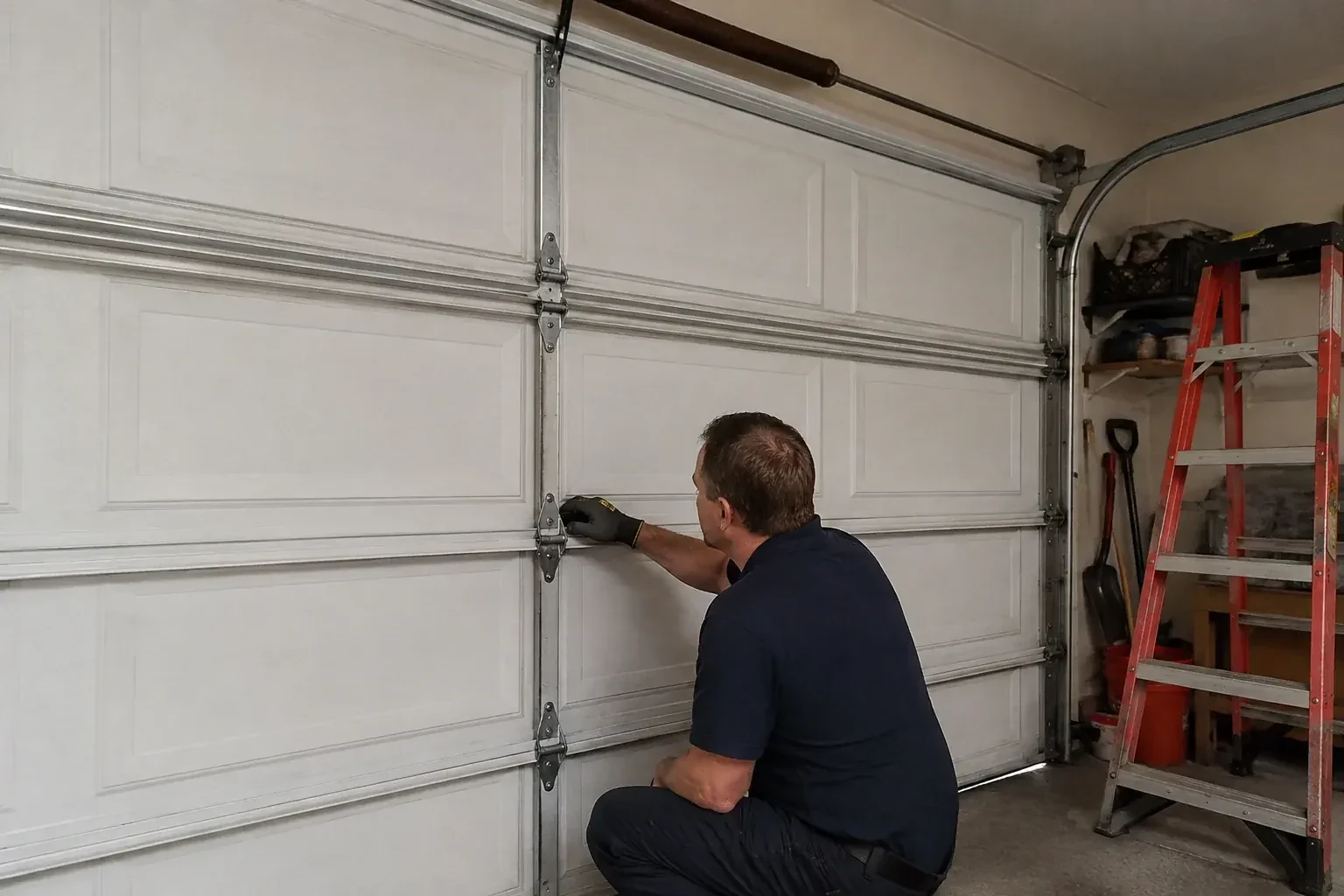
Watching from inside as the door opens, you can see the gap between the second and third panels open up on one side as they turn the corner into the ceiling, then close again. The other side stays tight.
Garage Door Hinge Replacement
In plain words
A hinge rarely fails on its own. A door that has drifted out of balance makes the opener drag it, and every hinge takes that strain on each trip. A roller whose bearing has seized twists the hinge that holds it. A track that has crept out of line makes the panels bind at the curve, and the hinge at that joint flexes until it cracks. Hinge replacement therefore begins with the whole door: rollers, track, balance and the panel edges around each hinge. The cause is corrected alongside the new hinge so the fresh part is not asked to absorb the same stress that finished the old one.
How the visit goesWatching from inside as the door opens, you can see the gap between the second and third panels open up on one side as they turn the corner into the ceiling, then close again. The other side stays tight.
Oro-Medonte
How the visit goes
Reading the number on each edge hinge
Every edge hinge carries a stamped number, and the technician reads it rather than assuming. A 1 sits at the joint above the bottom panel, a 2 at the next joint up, then 3, with 4 and 5 appearing on taller doors. The number sets how far the roller stands off the door, so the door leans into the jambs when closed and follows the track as it climbs. An earlier repair sometimes leaves a 2 where a 3 belongs, and that door binds or gaps at the curve for years without anyone knowing why. Confirming the number on each joint, and correcting any that are wrong, is part of the first look.
Hinge work after an impact
When a bumper or a bin has hit the door, the hinge is often bent along with the stile behind it. The technician removes the damaged hinge, straightens the stile with a dolly or fits a support plate where the steel has creased, and checks that the panel edges no longer touch when the joint flexes. A strut is added or straightened if the panel has bowed. The new edge hinge goes on with its roller, and the door is run through the curve by hand to confirm the panels turn without rubbing. Where a section itself is buckled, that is discussed as a separate decision.
What was fitted, written down
Before leaving, the technician tells you which hinges were replaced, their numbers and gauge, whether rollers or backer plates went on, and anything corrected along the way such as a wrong-numbered hinge or a loose track bracket. Write it inside the door manual or on a card near the opener, along with the door's make and panel count. Hinge widths and hole patterns vary between manufacturers, so the next technician, or you at the parts counter, can match parts without measuring from scratch. If some hinges were left in place as sound, their condition goes on the same note so you know what to watch.
Garage Door Hinge Replacement
In the van
- Heavy-gauge hinges for heavy doors
- Socket set and impact driver
- Hinge support plates
- Carriage bolts, nuts and washers
- Replacement rollers
What affects the quote
Same fees day, night or weekend
1Door width and panel count
A tall or double door has more joints and more hinges per joint, so a full-door hinge refresh on a double is a bigger job than the same work on a single.
2Condition of the mounting holes
Stripped or torn holes need a larger screw, a through-bolt with nut and washer, or a backer plate. That extra anchoring is small but is quoted separately from the hinge itself.
3How many hinges are changed
One cracked centre hinge is the smallest job. Several worn hinges across two or three joints, which is common on an older door, means more parts and more time, and the quote lists each.
Garage Door Hinge Replacement: questions
Can I tighten loose hinge screws myself?
Yes, hinge screws are a homeowner task. Disconnect the opener, leave the door closed, and snug each hinge screw with a socket wrench without forcing it, since overtightening strips the hole. Leave the bottom brackets alone; they anchor the cables and are under spring tension. If a screw spins freely or a hinge is cracked, stop there and have it looked at, because a stripped hole needs a fresh anchor rather than more turns.
What happens during a hinge replacement visit?
The opener is disconnected and the door left closed. The technician inspects every hinge, roller and screw hole and explains what was found. Worn hinges are then changed one at a time with parts of the same number and gauge, tired holes are re-anchored, and rollers are renewed where needed. The door is run by hand to check the panels fold cleanly and the fit against the jambs, balance is tested, and the opener is reconnected and its safety reversal tested.
What gauge of hinge does my door need?
Gauge runs backwards: a larger number means thinner steel. Light single doors often come with 18-gauge hinges, 14-gauge is the heavier standard for most residential doors, and 11-gauge is commercial stock. A heavy insulated double door, a door used many times a day, or a door whose hinges keep cracking benefits from the thicker option. The technician matches or improves on what was fitted, provided the width and hole pattern suit the stiles.
Springs & Hardware
- Garage Door Track Repair or ReplacementYou bought the house with a door that sticks near the top of its travel.
- Garage Door Cable ReplacementYour older door has springs along the tracks, and one cable has slipped off its pulley and dangles…
- Torsion Spring ReplacementNothing broke outright, but the door has grown heavier each winter, opens more slowly and squeals…
Garage Door Hinge Replacement near you
Our garage door services for Oro-Medonte are written up one by one so you can read exactly what happens during the visit. Spring and cable replacement, off-track repair, opener diagnosis, remote programming, weatherstripping, tune-ups, panel replacement and full door installation are all described in plain words.